| Submission Deadline |
|
|
| Notification of Acceptance |
| From March 15, 2026 |
| Early Bird Registration Deadline |
| April 15, 2026 |
| Registration Deadline |
| June 30, 2026 |
| Conference Dates |
| July 18-20, 2026 |


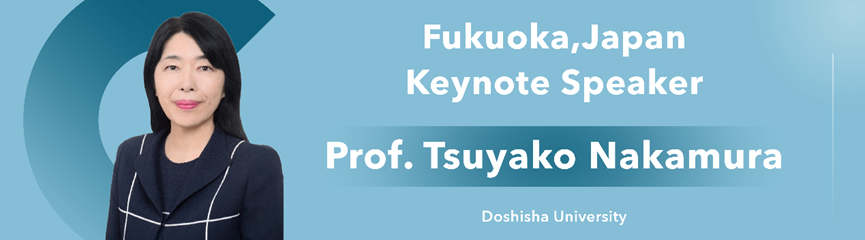
Tsuyako Nakamura is a professor at the Faculty of Global Communications of Doshisha University. Her specialty is women's labor issues in the U.S. and Japan. Currently, she is researching work-life integration and employment policy for women's advancement with Grant-in-Aid for Scientific Research from the Japan Society for the Promotion of Science (JSPS).Her major publications include co-authored books,Work-LifeIntegration (2021), Human ResourceManagement in the Era of EVP (Employee Value Proposition) (2018), Work-life Balance and Management(2017) and Creating Gender Equal Workplace(2004). She finished her Ph.D. course at Doshisha University after obtaining M.A. at MontereyInstitute of International Studies in California as a Rotary International student. She was a Fulbright Visiting Scholar at Stanford University and Harvard University in 2009-2010. She has been active for social leadership programs including TOMODACHI MetLife Women's Leadership Program as the first-year mentor/chaperone(2013), and Kansai Economic Federation's women's empowerment program as coordinator (2014-2023).From June 2021 to August 2024, she served as president of the Japan Academy of Labor Management.
Work–Life Integration as a Framework for Transforming Japan’s Labor Regime
Japan’s gendered Fordist employment regime—anchored in the male breadwinner model, seniority-based employment, and the privatization of care—long underpinned the nation’s economic growth. Today, demographic decline, labor market dualization, shifting life-course aspirations, and digital transformation are destabilizing this foundation. Government-led work–life balance initiatives and work style reforms have sought to respond, yet deep organizational path dependencies and managerialist logics sustain a persistent gap between policy and practice. The rapid rise and retreat of telework during the COVID 19 pandemic further reveal the resilience of legacy institutions. This keynote reinterprets these developments through the lens of work–life integration (WLI), which conceives work and life as interdependent domains embedded in socio technical systems. By situating WLI within Japan’s historical employment trajectory, it clarifies the conceptual limits of WLB and identifies the institutional and cultural conditions for realizing more integrated futures of work and care. The analysis contributes to global debates on post Fordist labor regimes and the transformation of social reproduction.
| Submission Deadline |
|
|
| Notification of Acceptance |
| From March 15, 2026 |
| Early Bird Registration Deadline |
| April 15, 2026 |
| Registration Deadline |
| June 30, 2026 |
| Conference Dates |
| July 18-20, 2026 |